The road climbs out of a fishing village just before sunrise. Salt air. A stray dog sleeping across the white line. Somewhere ahead, the coast bends south and the tarmac empties out completely. You could be doing this by bus. You’re not.
That is what motorcycle travel in Sri Lanka offers. A version of the country that tour packages simply cannot sell you. But getting here requires more than booking a bike and hoping for the best. There are legal requirements most tourists overlook, road dynamics that catch experienced riders off guard, and rental traps that will cost you money if you are not prepared.
This guide covers everything clearly, before you ride.
Is Riding a Motorbike in Sri Lanka Right for You?

Sri Lanka is not one type of riding destination. The terrain, traffic, and road conditions change dramatically depending on where you are heading, and your comfort level on a motorbike should honestly shape your decision before you book anything.
The coastal roads running from Colombo down to Tangalle are generally wide, reasonably surfaced, and manageable for riders with moderate experience. Traffic outside major towns is lighter, the terrain is flat, and the roads are forgiving enough that an intermediate rider can relax and enjoy the scenery.
The hill country is a completely different challenge. Roads to Ella, Nuwara Eliya, and the central highlands are steep, narrow, and frequently wet. Hairpin bends appear without warning. Fog rolls in fast at elevation. Riders who have only ridden on flat urban roads will find the highlands genuinely demanding.
A few things to factor in before you commit:
- Motorcycles are banned on Sri Lanka’s expressways. All riding happens on B-roads and national highways, which means sharing lanes with trucks, buses, tuk-tuks, and the occasional herd of cattle.
- Traffic moves on the left. If you’re coming from a right-hand-drive country, budget a day of easy riding in a quieter area before tackling busier routes.
- Colombo city traffic is dense and aggressive. Most experienced riders who rent in Sri Lanka suggest leaving Colombo by bus or train and picking up a bike further along the coast, away from city congestion.
If you have ridden in Vietnam or Thailand before, Sri Lanka will feel familiar. If this is your first time riding in a developing country, start slow, stay coastal, and build your confidence before heading inland.
The Legal Stuff: How to Get Your Sri Lankan Motorcycle Permit

This is where most tourists make costly mistakes, so let’s be direct: your home country driving license alone is not legally valid for riding in Sri Lanka. An International Driving Permit (IDP) alone is also not enough. You need a Sri Lankan recognition permit on top of both documents.
Some rental shops will wave you through without asking. That does not make you legal. If police stop you without a valid local permit, you face fines of up to LKR 25,000, potential impounding of the bike, and your travel insurance becomes void in the event of an accident. The risk is entirely on you.
There are two practical ways to sort this before you ride.
Option A: The BIA Airport Counter (Fastest Route)

Bandaranaike International Airport has a Department of Motor Traffic (DMT) counter located near the SPAR shop in the arrivals walkway. It operates 24 hours a day, seven days a week, which means you can handle this the moment you land, at any hour.
What to bring:
- Your home country motorcycle driving license
- Your passport
- A certified translation of your license if it is not in English
The cost runs between LKR 2,000 and LKR 10,000 (approximately USD 7 to USD 50) depending on license class and duration. Processing is usually quick during off-peak arrival times. This is the most straightforward option and the one most travelers use.
Option B: AAC Endorsement (Pre-Arrival)
The Automobile Association of Ceylon (AAC) can process a riding permit on your behalf before you arrive. Some rental companies offer this as part of their booking service, handling the paperwork through the AAC for approximately USD 40.
If you want to ride immediately after landing without queuing at the airport, this is worth exploring with your rental company during the booking process.
One important detail to check: your IDP must be issued under the 1949 Geneva Convention. Some countries issue IDPs under the 1968 Vienna Convention, which Sri Lanka does not recognise for permit purposes. Confirm this with your home country automobile association before you travel.
How Much Does Motorcycle Hire Cost in Sri Lanka? (2026 Prices)

Rental rates across Sri Lanka vary by bike type, location, and the reputation of the rental shop. The prices below reflect current market rates. However, Sri Lanka has experienced notable inflation and currency fluctuations in recent years, and costs can shift meaningfully in a short period. Treat these figures as reliable estimates and always confirm current pricing directly with your rental provider before booking.
Scooters (110cc to 125cc): USD 8 to USD 15 per day Common models include the Honda Dio, Honda Wego, and TVS NTorq. These are well-suited for coastal cruising, town riding, and lighter terrain.
Motorcycles and Cruisers (150cc to 350cc): USD 15 to USD 35 per day Common models include the Bajaj Avenger, Bajaj Pulsar, and Royal Enfield Classic 350. For the hill country, the extra torque genuinely matters.
Fuel

Sri Lanka mostly uses 92-octane (95 octane is also available but in limited Gas stations). Gas stations are full-service, meaning an attendant pumps for you. Always watch the attendant reset the pump meter to zero before they start. Pump-skimming, where the attendant begins pumping from a non-zero reading, is a known scam at certain stations and costs you money on every fill without being obvious.
Deposits
Most rental shops require either a cash deposit of USD 50 to USD 100 or will hold your passport as security. Handing over your passport carries real risk. Negotiate a cash deposit instead where possible and keep your travel documents with you at all times.
Petrol vs. Electric: Which Bike Fits Your Plan?

Electric scooters have started appearing at rental shops in Colombo and some coastal towns. For short city rides or flat coastal hops, they are a quiet and practical option. Outside major urban areas, however, Sri Lanka’s EV charging infrastructure is still developing, and range limitations become a serious issue once you head inland. For the highlands or any multi-day touring, petrol is the only reliable choice.
Insurance: Protect Yourself and the Bike

Standard rental bikes in Sri Lanka come with basic Third-Party Liability coverage. This protects other people on the road but does not cover damage to the rented bike or your own medical costs.
Ask your rental shop specifically about CDW (Collision Damage Waiver) coverage. Not every shop offers it, terms vary, and having it significantly reduces your financial exposure if the bike gets damaged.
Your personal travel insurance is the other side of this. Many standard travel policies exclude motorbike riding entirely. Providers like SafetyWing and World Nomads offer adventure add-ons that cover motorcycle use, but read the fine print carefully, particularly around engine size limits and license requirements. If your policy requires a valid local license to cover you, the Sri Lankan recognition permit becomes both a legal requirement and an insurance one.
Safety on Sri Lankan Roads

Riding safely in Sri Lanka means adapting to a set of road dynamics that differ meaningfully from what most Western riders are used to.
- Buses and trucks own the road. They overtake on blind corners, do not slow for merging traffic, and will not brake for you. When a large vehicle approaches from either direction, pull left and give it space. This is not a courtesy. It is survival logic.
- Ride during daylight only. Animals including dogs, cattle, and occasionally elephants near certain wildlife zones wander onto roads after dark. Road lighting outside of cities is minimal or nonexistent, and potholes that are easy to spot in daylight become invisible after sunset.
- Expect tuk-tuk behaviour. Three-wheelers filter through traffic constantly, stop without signalling, and treat lane markings as loose suggestions. Factor them into your awareness at all times, especially in and around towns.
- Wear a helmet. Sri Lankan law requires helmets for both the rider and any passenger. Beyond the legal requirement, road surfaces can be unpredictable and a properly fitted helmet is cheap insurance relative to any alternative.
Best Motorcycle Routes in Sri Lanka
Route 1: The South Coast Loop (Beginner to Intermediate)
Colombo to Galle to Mirissa to Tangalle
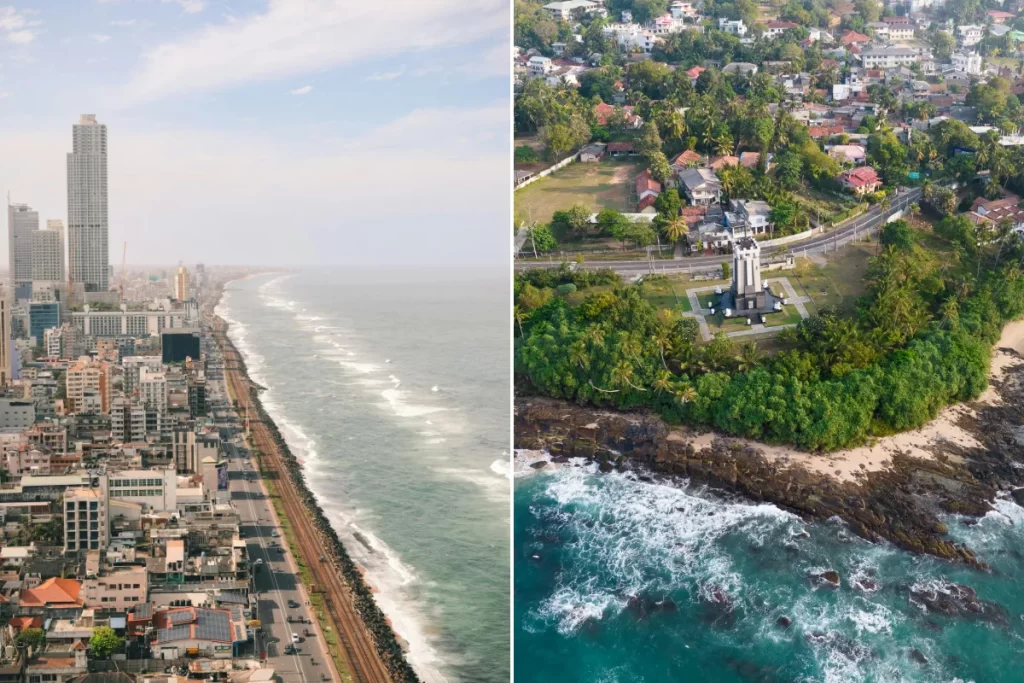
This is the most popular riding route on the island for good reason. The coastal highway offers consistent road quality, sweeping ocean views, and a string of towns that reward stopping. Galle Fort alone justifies the ride down from Colombo, and Mirissa is an ideal spot to break the journey before pushing further east to Tangalle.
Budget two to three days to cover this loop comfortably. The roads are manageable, distances are reasonable, and the scenery makes you want to slow down rather than rush through.
Route 2: The Hill Country Loop (Advanced)
Tangalle to Ella to Nuwara Eliya to Kandy

Save this one until you are confident on the bike. The ascent into the highlands from the south coast is dramatic and the roads are unforgiving in wet conditions, which come frequently. Ella is a natural rest point, and the ride from Ella to Nuwara Eliya through tea plantation country is one of the most visually striking stretches of road in South Asia.
Allow four to five days and check weather forecasts before entering the highlands. Mist and rain can descend quickly, and riding on narrow mountain roads in low visibility is a different experience entirely from coastal cruising.
Route 3: The Cultural Central Route (Intermediate)
Colombo to Kandy to Sigiriya to Dambulla

This route connects Sri Lanka’s cultural triangle by road and rewards riders with a mix of scenery and history. The ride from Colombo to Kandy is manageable but busy through Kadugannawa pass, so take your time on the ascent. North of Kandy, the roads open up and the landscape shifts toward the dry zone plains.
Quick Rent and Ride Checklist

Before you leave the rental shop, run through this:
- Confirm your Sri Lankan recognition permit is valid and matches your license class
- Photograph every existing scratch, dent, and scuff on the bike before moving it
- Test the brakes, horn, lights, and indicators in the car park
- Check that the helmet fits correctly and that the strap is fully functional
- Save the rental shop’s contact number in your phone
- Confirm the process if the bike breaks down mid-route
- Get clarity on the fuel policy (return full or return as rented)
- Ask explicitly what the insurance covers and, more importantly, what it does not
Frequently Asked Questions
Do I need an IDP to rent a scooter in Sri Lanka?
An IDP is part of the requirement, but it is not sufficient on its own. You need your home country motorcycle license, a valid IDP issued under the 1949 Geneva Convention, and a Sri Lankan recognition permit obtained through the DMT or AAC. All three together make you road-legal.
What happens if the police stop me without a local permit?
You can be fined up to LKR 25,000, the bike may be impounded, and your travel insurance coverage becomes void. Any rental shop that allows you to ride without proper documentation is placing that risk entirely on you.
Can two people ride on one scooter?
Yes, it is legal, but both rider and passenger must wear helmets. For hilly terrain or longer rides, a 150cc bike handles the additional weight significantly better than a 110cc automatic. On a small scooter, the hills will fight back.
What is the best motorbike for first-time riders in Sri Lanka?
Is riding a motorbike in Sri Lanka safe?
It carries real risk. Road conditions and traffic behaviour are less predictable than in most Western countries. Thousands of tourists ride here every year without incident, but they do so by staying alert, avoiding night riding, respecting larger vehicles, and riding within their actual skill level, not their aspirational one.
How do I find a reputable motorcycle rental shop in Sri Lanka?
Look for shops with verifiable Google reviews, clear written rental agreements, and staff who ask about your license before handing over keys. Any shop that does not ask about your licensing should be treated with caution. Cheap daily rates often come with hidden costs elsewhere.
Are Royal Enfields worth renting for a Sri Lanka tour?
For the hill country, yes. The torque and build quality handle mountain roads well, and the Classic 350 is genuinely enjoyable on long stretches. For flat coastal riding, they are more bike than you need and cost more per day. Match the machine to the terrain, not your ego.
What should I do if the bike breaks down?
Contact the rental shop immediately and do not leave the bike unattended on a busy road. Most reputable shops have a breakdown support number. Make sure you have this number before you ride out. Sorting it after a breakdown, on the side of a road you do not know, is not the time to discover they never gave you one.
Is travel insurance valid when riding a motorbike in Sri Lanka?
Only if your policy explicitly covers motorcycle use. Many standard policies do not. Check your coverage before you travel and add a motorcycle or adventure sports rider to your policy if needed. Assuming you are covered is not the same as being covered.
Can I rent a motorcycle and ride the whole island?
Yes, and many travelers do complete multi-week circuits of Sri Lanka by bike. Plan your recognition permit duration accordingly when applying at the DMT, and factor in that expressways are off-limits throughout. Taking national highways and B-roads adds time to inter-city legs but also adds scenery that you would miss entirely on an expressway.ShareProject contentSriLankaHolidayGuides.comCreated by youAdd PDFs, documents, or other text to reference in this project.Contentpdf
Further Readings
- Decoding Driving Signals in Sri Lanka: A Traveler’s Guide
- Is It Safe to Rent and Drive Your Own Car in Sri Lanka as a Tourist?
- Solo Travel in Sri Lanka: Best Places, Safety, and Tips
- Ella Travel Guide: Things to Do, Best Time to Visit & Easy Tips
- Mirissa Travel Guide: Whale Watching and Beach Hopping in Sri Lanka